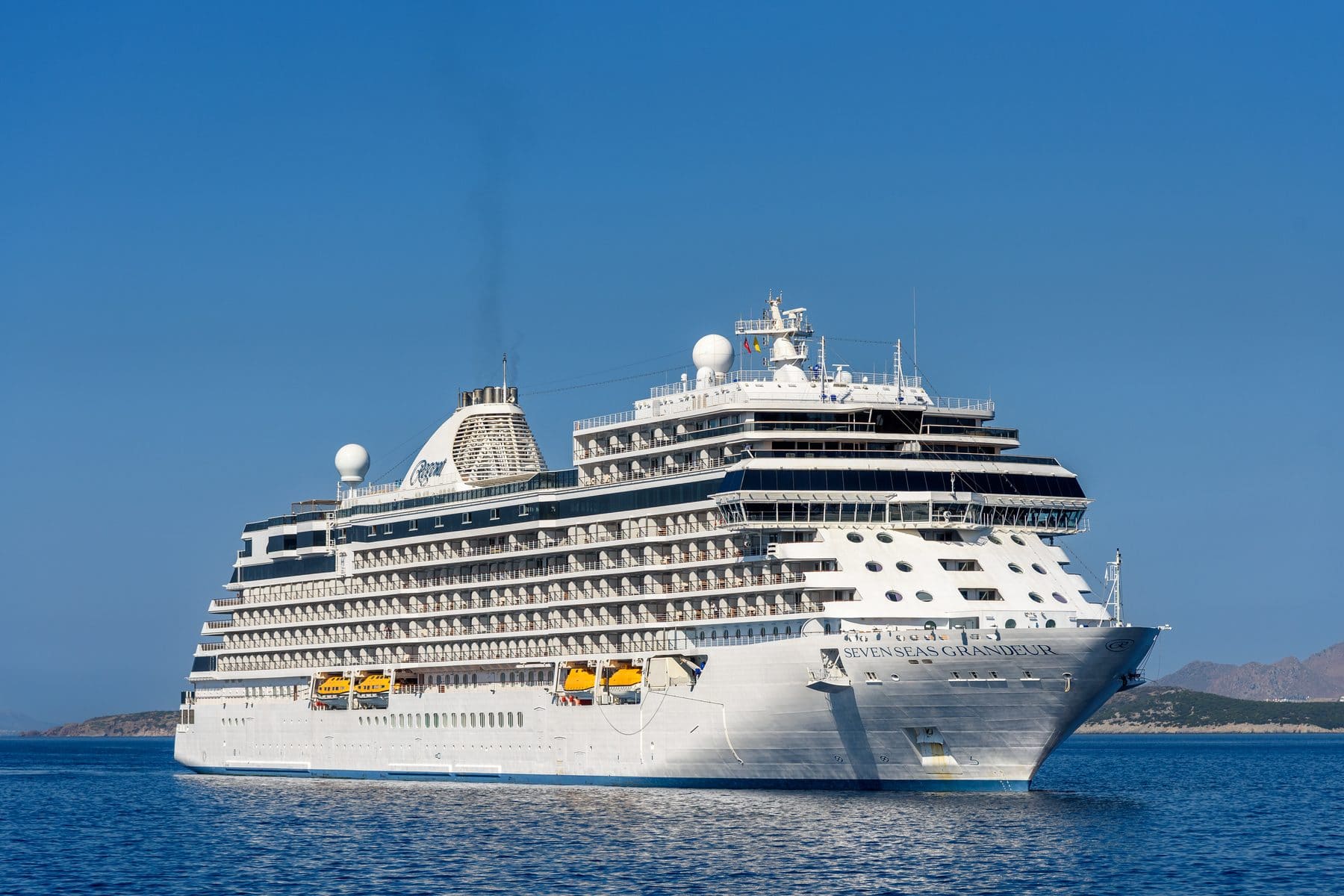
Regent's Concierge Suite favors full-time wheelchair users
Regent is our first choice for full-time wheelchair users prioritizing roomy suites, roll-in showers, and conventional ship plans. Seabourn better serves couples requiring a transfer shower, comfortable with tighter expedition logistics, and drawn to open dining. For grandparents funding several cabins, Regent offers a stronger baseline because accessible accommodations cover more ships and suite categories. Seabourn Venture and Seabourn Pursuit fit active couples whose mobility works with tenders, gangways, and restricted onboard assistance.
Regent lists accessible accommodations across Seven Seas Explorer, Seven Seas Grandeur, Seven Seas Splendor, Seven Seas Voyager, Seven Seas Mariner, and Seven Seas Navigator. Categories extend from Deluxe Suite F through Concierge and Penthouse suites. Seabourn's expedition deck plan identifies five wheelchair-accessible suites across Decks 7 and 8. That smaller pool requires earlier category decisions, especially when one traveler needs a specific shower arrangement rather than simply extra floor area.
A couple using one wheelchair part time may prefer Seabourn's simpler social rhythm and open restaurant seating. A traveler needing more turning room should begin with Regent's 450-square-foot Penthouse Suite C 916 on three ships. Families must solve a different problem because an accessible suite does not automatically connect to a second cabin. The correct choice depends on who sleeps together, who provides assistance, and whether the wheelchair remains beside the bed overnight.
Neither line suits every mobility profile. A guest who cannot manage tenders should favor docked-heavy routes and treat Seabourn's expedition ships cautiously. A family requiring supervised children's programming should compare Cunard's Grills before committing to either choice. Travelers needing a different accessible layout can also place Silversea beside Regent and Seabourn during planning. The booking decision should begin with physical requirements, not the line's overall reputation or a preferred restaurant concept.
Suite 916 gives Regent the space advantage
Seven Seas Explorer's Concierge Suite D 822 and 823 each provide 332 square feet inside and a 132-square-foot balcony. Their bathrooms have seated roll-in showers, two sinks, and open space beneath the vanity. Balcony ramps and electronic curtains reduce two common barriers. The tradeoff is storage: these suites replace a walk-in closet with a large built-in cabinet. The same category, suite numbers, and dimensions appear on Seven Seas Grandeur and Seven Seas Splendor.
Penthouse Suite C 916 supplies Regent's clearest space advantage on Seven Seas Explorer, Seven Seas Grandeur, and Seven Seas Splendor. Each version measures 450 square feet inside with a 176-square-foot balcony. The bathroom has a seated roll-in shower, one sink, and open knee space beneath it. A walk-in closet remains available, unlike in Concierge Suite D. This category works better when a wheelchair, transfer equipment, and a companion must share the room without blocking circulation.
Seven Seas Voyager provides smaller accessible Penthouse Suite B options in suites 859 and 860. Each has 325 square feet inside and a 52-square-foot balcony. Concierge Suite D 761 and 762 retain the same interior area, with 55-square-foot balconies. Their threshold solutions differ: suite 761 uses fabricated ramps at the bathroom and balcony, while suite 762 has a fabricated balcony ramp only. Travelers should match that distinction to the user's transfer ability.
Seven Seas Mariner's accessible Deluxe Suite F 828 and 829 measure 269 square feet, plus 51-square-foot balconies. Accessible Concierge suites on Decks 9 and 10 share those dimensions and use ramps across bathroom and balcony thresholds. Seven Seas Navigator offers more room in Concierge Suite D 832 and 833 or Penthouse Suite C 928 and 929. Each measures 390 square feet with a 71.5-square-foot balcony, although the sitting area has two chairs instead of a sofa.
Open seating sets Seabourn's easier daily pace
Seabourn keeps meals flexible for travelers whose morning routine can take longer than expected. Most restaurants use open seating at breakfast, lunch, and dinner. The Restaurant, The Colonnade, and Patio Grill normally require no reservation. That arrangement reduces the pressure of reaching a fixed table at a precise time. It also lets a wheelchair user choose a quieter dining period, while companions can adjust meals around medication, rest, or a delayed return from shore.
Twenty-four-hour room service gives Seabourn another practical advantage after a tiring port day. A traveler can dine in the suite rather than cross several decks when pain or fatigue increases. The benefit matters most on Seabourn Venture and Seabourn Pursuit, where expedition activity may produce an uneven daily schedule. Room service also helps a companion remain nearby during personal care. It should not replace checking whether the dining table and approach work with the traveler's chair.
Seabourn's dress rule keeps evenings manageable without requiring formal clothing. Shorts and jeans are accepted in lounges and dining venues during the day. After 6 p.m., the line uses an elegant-casual standard. Men can wear slacks with a collared shirt or sweater, while jackets remain optional. Women can choose slacks, a skirt, a blouse, a pantsuit, or a dress. Dressy jeans are accepted, which helps travelers who find complicated clothing changes physically demanding.
Regent may still suit a traveler who prefers a larger private living area over Seabourn's looser dining rhythm. Suite 916 supports a more spacious in-room routine, while Seabourn reduces scheduling pressure outside the cabin. Travelers new to luxury cruising should decide which friction matters more. Extra square footage helps equipment placement and transfers. Open seating helps when personal care changes the day's timing. Couples with predictable routines may barely notice the difference, while variable mobility makes it consequential.
Grandparents need the right third-guest arrangement
Families should assign the accessible suite to the person needing its bathroom, not automatically to the person paying. Seabourn Venture and Seabourn Pursuit mark third-guest suites where the sofa becomes a twin-size bed. That arrangement may work for a teenager or adult companion, but it changes circulation after bedtime. A wheelchair user must still reach the bathroom and exit. Three adults should inspect the opened-bed layout before treating one suite as a workable shared room.
Treat Seabourn's connecting arrangements separately from its wheelchair inventory. Suites 733 and 735 form Grand Wintergarden Suite 7353, while 734 and 736 create Grand Wintergarden Suite 7364. None of those numbers matches the five wheelchair-accessible suites. Families therefore cannot presume either Grand Wintergarden pairing has an accessible bathroom. Grandparents and children may fare better in a neighboring second suite than with a connection unsuitable for the wheelchair user's doorway width, shower setup, or turning space.
A traveler unable to handle dressing, eating, or safety drills independently must sail with a capable companion on Seabourn. That rule affects multigenerational room assignments. A grandchild in another corridor cannot function as the practical helper during an emergency. The companion should sleep close enough to assist throughout the night and understand the traveler's routine. Regent families should apply the same planning discipline even when a larger Penthouse Suite makes movement and equipment storage easier.
Infants must be at least six months old at Seabourn embarkation, which matters when grandparents plan a three-generation trip. Teenagers may appreciate the ship's small scale, but parents seeking a structured daily children's program should not choose solely around the accessible cabin. Couples and adult families fit both lines more naturally. Larger family groups should compare separate cabins, nearby rooms, and a Cunard Grills alternative before making accessibility compete with supervision needs.
Included dining changes Seabourn's onboard budget
Seabourn includes every onboard dining venue, which simplifies meal planning for a wheelchair user and companion. The traveler can select a restaurant by fatigue level and route accessibility rather than by a surcharge. Open seating also permits families to divide occasionally without wasting a prepaid dining reservation. Regent buyers should ask for an itemized fare explanation for their chosen departure. The accessible suite category alone does not determine which transportation, hotel, or shoreside arrangements accompany that booking.
Seabourn includes selected spirits and wines throughout the voyage, while ordinary onboard tipping is neither required nor expected. Those inclusions reduce repeated transactions in lounges and restaurants. They do not make every mobility-related service part of the fare. A personal care attendant remains the traveler's responsibility. Staff members do not replace a capable companion for dressing, eating, or drills. Families should separate hospitality service from hands-on assistance when comparing the apparent value of the two lines.
Unlimited-minute Wi-Fi is included with every Seabourn booking. That can help companions coordinate with relatives across several suites or contact providers during the voyage. Connectivity should not become the basis for relying on remote help during transfers or emergencies. Regent's larger named accessible categories may justify their place in the comparison without assuming identical inclusions. Compare the complete booking, including the precise suite, air arrangements, transfers, hotels, excursions, and any equipment rental needed before embarkation.
Accessible shore transportation remains a separate planning problem on either line. Seabourn uses third-party operators whose vehicles and facilities may not accommodate every wheelchair. Coach drivers follow the operator's assistance policy, not Seabourn's. A scooter may need loading into a luggage compartment by someone in the traveler's party. Treat private vehicles, equipment rentals, and personal assistance as separate arrangements unless they appear explicitly in the confirmed booking.
Tender rules decide remote itineraries after October 2026
Choose docked-heavy routes for departures after October 2026 when the traveler cannot manage steps, steep gangways, or manual transfers. Tender operations and some gangways may not accommodate wheelchairs or scooters. Low or high tide can also change the boarding angle at a dock. Regent's conventional ships are the safer comparison starting point when going ashore matters every day. Seabourn Venture and Seabourn Pursuit make more sense when missing a landing would not spoil the trip.
Seabourn restricts tender transfer for scooters or wheelchairs weighing more than 100 pounds without the battery. That rule can exclude substantial powered chairs even when the guest can transfer independently. The chair's weight must be checked before selecting a tender-heavy route. Folding equipment may still require a companion to handle loading. A lightweight travel chair can improve port options, but it must fit the user's posture and transfer needs. Equipment convenience should never override safe daily use.
Remote routes demand another age check for multigenerational parties. Children must be at least 12 months old on trans-ocean crossings and remote itineraries containing more than two consecutive sea days. That rule may remove Seabourn expedition departures from consideration for a family with a younger infant. Adult groups face a different calculation. They should weigh destination value against the chance that the wheelchair user remains aboard during a landing, particularly when the route's main purpose is going ashore.
For November 2026 and 2027 planning, inspect every port as docked, tendered, or operationally uncertain. Wind, swell, and extreme tide can prevent assistance between ship and tender. The captain makes the final safety decision about assisting a mobility-limited guest or carrying mobility equipment. No suite category overrides that call. Travelers who value the ship as much as the landings can accept this uncertainty more easily. Those booking for specific shore days should select the least tender-dependent sequence available.
Transfer showers make Seabourn the better fit for some
Seabourn wins when a traveler needs a transfer shower rather than a roll-in arrangement. Suites 738 on Deck 7 and 800 and 824 on Deck 8 provide transfer showers and wheelchair-accessible doorways. That configuration may suit someone who can make a controlled lateral movement but wants a defined shower edge. Regent's accessible inventory centers on larger roll-in showers. The better bathroom is determined by the user's actual transfer method, balance, reach, and caregiver position, not by room size alone.
Seabourn also offers roll-in showers in suites 737 on Deck 7 and 825 on Deck 8. These two accommodations provide wheelchair-accessible doorways without forcing every accessible guest into a transfer-shower design. A couple needing one cabin can therefore choose between two bathroom approaches on Seabourn Venture or Seabourn Pursuit. Availability remains concentrated in five suites, so the shower decision must precede preferences about deck position, view, or proximity to shared spaces.
Seabourn's accessible suites use suite and bathroom entry doors at least 32 inches wide. Their showers include grab bars, a bench or seat, and a handheld shower head. Lowered closet and towel rods reduce overhead reaching. These features may outweigh Regent's extra floor area for a traveler whose main barriers are reach and bathroom transfers. A compact manual chair and an independent user can fit this profile better than someone carrying a large powered device and extensive transfer equipment.
Regent wins again when several accessible categories or more interior space matter more than shower choice. Seven Seas Navigator's 390-square-foot Concierge and Penthouse suites provide a middle ground, while Suite 916 supplies the largest named option in this comparison. Seabourn is not the prudent choice for someone expecting crew members to push a wheelchair around the ship. Routine wheelchair assistance is limited to embarkation, disembarkation, and emergencies, leaving normal onboard movement to the guest and companion.
Confirm doorway, shower and gangway measurements
Start with a written mobility profile before selecting Regent or Seabourn. Record the chair's width, length, unladen weight, turning circle, and battery type. Add the user's transfer direction, shower method, bed approach, nighttime assistance, and ability to manage thresholds. Seabourn recommends submitting its Special Requirements Information form when booking or at least 45 days before departure. Earlier disclosure matters most when only five accessible suites exist on Seabourn Venture and Seabourn Pursuit.
Match the profile to a specific suite number rather than a general category. On Seven Seas Explorer, Suite D 822 differs materially from Penthouse C 916 in space, sinks, storage, and balcony size. On Seven Seas Voyager, suites 761 and 762 do not use identical threshold ramps. Ask for the bed's approach width, toilet transfer side, shower-seat position, balcony threshold, and space remaining after any sofa bed opens. Photographs should show the actual accessible configuration.
Plan equipment storage before assuming the cabin floor will remain clear. Seabourn requires mobility devices to be stored and charged inside the guest's suite, not in corridors. A scooter can therefore consume space intended for transfers or the third guest's bed. Confirm outlet location and safe charging requirements, then map an unobstructed route from bed to bathroom and exit. Families using two cabins should decide which room stores backup equipment, shower chairs, or a folded travel wheelchair.
Build the final comparison around the traveler's hardest day, not their strongest one. Review tender frequency, gangway steps, companion duties, airport assistance, accessible transportation, and medical storage alongside the suite plan. Include Silversea, Cunard's Grills, or another appropriate line only when neither primary option meets the physical brief. Before booking, confirm the exact suite number, doorway width, shower type, threshold ramps, equipment storage, tender schedule, and companion requirements with an accessibility specialist.
Questions people ask
Good to know
Questions, answered
Can Seabourn provide a wheelchair for the entire cruise?
Bring your own wheelchair if you expect regular use. Seabourn limits complimentary wheelchair assistance to embarkation, disembarkation, and emergencies. Ship wheelchairs are not intended for routine movement between the suite, restaurants, and lounges. Advance rental can be arranged through an outside provider. The user and companion remain responsible for ordinary movement aboard Seabourn Venture, Seabourn Pursuit, and other ships.
Can I keep refrigerated medication in my Seabourn suite?
Refrigerated medication may be stored in the suite refrigerator. Label every medication with the traveler's full name and cabin number, including items kept elsewhere. Request a sharps container from the Suite Host or Suite Attendant after boarding. Needles, lancets, and blades must go into that container. Travelers with food-related allergies should also speak with the Dining Room Manager after embarkation.
Are service animals allowed on Seabourn ships?
Seabourn permits trained service animals that perform work for a person with a disability. Current vaccination records must be supplied to Guest Accessibility before boarding. Every destination can impose its own documentation, quarantine, or landing rules. Missing paperwork may prevent the animal from going ashore at a port. Discuss the complete itinerary before confirming any Seabourn departure with a service animal.
Do Regent accessible suites have bathtubs?
The listed Regent accessible bathrooms replace the bathtub with a large roll-in shower. Configurations vary by ship and category. Seven Seas Explorer's Concierge Suite D has two sinks, while Penthouse Suite C has one. Seven Seas Navigator's accessible suites also replace the sofa with two chairs and a table. Travelers should select by exact suite number because furnishings, ramps, storage, and balcony access differ.
Will Seabourn staff load my scooter onto an excursion coach?
Do not assume the driver or ship staff will load it. Assistance policies belong to the third-party tour operator. When a scooter travels in the coach's luggage compartment, someone in the party may need to load it and climb the front steps. Ask about vehicle lifts, storage dimensions, securement, and walking distance before reserving the excursion. The same check applies when arranging independent transportation.
Still have a question? Book a free 30 minute call or send us the brief.
Sources
Where to go next
- Cruise lines: Who each line is for, and who it isn't for.
- Compare ships: Our ratings for every line we sell.
- Book a free 30 minute call: Tell us who is traveling; we will shortlist the ships we would consider.