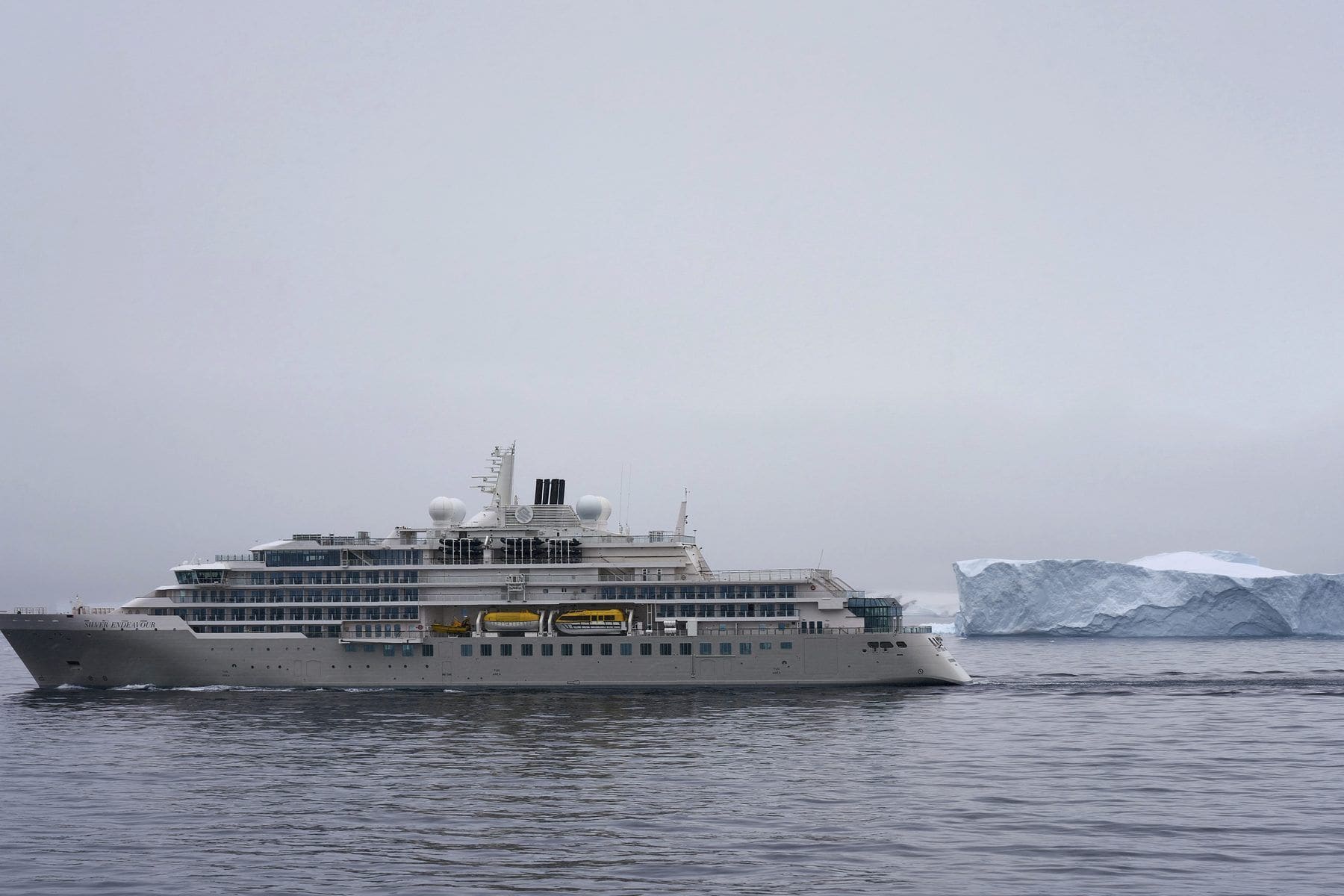
Lindblad families or Silver Endeavour couples
Choose Lindblad for active families, teenagers and travelers who want the expedition program to lead the day. Choose Silversea for couples and grandparents who place greater weight on suite service, dining choice and a more familiar cruise rhythm. Lindblad’s National Geographic Endurance and National Geographic Resolution carry 138 guests each. Silversea’s Silver Endeavour carries 220 guests, giving the ships distinctly different social scales before anyone boards a Zodiac or attends an evening briefing.
Silversea is usually easier for first time polar travelers who want an expedition without giving up a full-service ship. Every Antarctica suite has butler service, while the ships also provide a spa and fitness center. Silver Endeavour adds an enclosed pool and deck. The combination gives couples more ways to spend a canceled landing period. Travelers who dislike organized youth activities may also prefer this quieter, adult-oriented onboard pattern, especially during longer November through March sailings.
Lindblad better suits a family that regards the ship as a working base rather than a resort. Its under-18 program connects observation, photography and field science to the places visited. National Geographic Explorer carries 148 guests, close enough to Endurance and Resolution for a similarly close-knit expedition culture. The atmosphere encourages participation and conversation. Couples seeking several restaurant choices, extensive suite service or a conventional evening routine may find that emphasis too consuming after consecutive landings.
Book the ship rather than relying on either company name alone. Silver Cloud carries 254 guests, compared with Silver Endeavour’s 220, while Lindblad’s principal polar ships remain below 150. That difference affects briefing crowds, dining patterns and the number of people sharing public rooms. It does not decide landing quality by itself. Travelers should choose Lindblad when learning and family engagement lead. They should choose Silversea when private space, staffed suites and flexible downtime matter more.
Category 7 meets Silver Endeavour’s all-suite scale
Lindblad offers the smaller passenger count, while Silversea provides more suites and broader hotel facilities. National Geographic Endurance and Resolution each have 76 outside cabins and suites for 138 guests. Their accommodation runs from Category 1 through Category 7, plus Category A Solo and Category B Solo. Category 7 is the Junior Suite level. This inventory suits couples and solo travelers well, but families should treat any need for adjoining or internally connected rooms as a ship-specific requirement.
Category 7 on National Geographic Explorer gives families one useful configuration. Suites 215, 219 and 230 have a private balcony, separate sitting area and pullout sofa. Explorer also has Category 3 Triple cabins, providing another option for three travelers sharing. Categories A and B serve single occupants. Most standard cabins can be arranged with a queen bed or two singles, while solo cabins retain one single bed. That flexibility helps groups divide grandparents, parents and children across several categories.
Silver Endeavour has 110 suites for 220 guests, creating a simple two guests per suite shipwide ratio. Silver Cloud has 127 suites for 254 guests and carries 20 Zodiacs. Those totals do not reveal which accommodations connect, so a multigenerational party should never build its plan around two neighboring suite numbers alone. Silversea remains the stronger choice when each couple wants a separate suite, a butler and access to larger hotel spaces rather than a compact expedition layout.
Balconies are widely available on Lindblad’s newer polar ships but are not universal across every category. Endurance and Resolution place balconies in Categories 3 through 7 and in their solo accommodations. Explorer reserves private balconies for Category 5 and Categories 6 and 7, while some other cabins have them. A balcony can be useful for private wildlife viewing, yet exposed conditions often send guests toward the observation lounge or open deck. Prioritize occupancy and location before outdoor space.
Two Seven Zero meets four Silversea restaurants
Lindblad keeps meals social, casual and closely tied to the expedition schedule. Endurance and Resolution have Two Seven Zero, an Observation Deck restaurant and a Chef’s Table. The two main restaurants use unassigned seating and emphasize locally influenced, sustainably sourced food. National Geographic Explorer serves meals in a single seating at unassigned tables, which encourages guests to meet beyond their own party. This arrangement works for sociable families but offers less separation for couples wanting the same private table nightly.
Silversea provides more conventional restaurant choice and a higher-touch suite routine. Silver Endeavour and Silver Cloud each list four dining options. Silver Endeavour also has Arts Café, while Silver Cloud offers Panorama Lounge and Dolce Vita among its public venues. Every Antarctica suite receives butler service. That structure makes Silversea better for couples who want breakfast handled privately, grandparents who value practical assistance, and groups that prefer to split up before meeting later for dinner.
Lindblad’s pace starts with fieldwork and fits meals around it. Zodiacs, kayaks, remotely operated vehicles, hydrophones and underwater video equipment support a day built around conditions and wildlife. Guests can choose among activities and work at different speeds, but the ship’s energy remains expedition-first. Travelers who want leisurely lunches, long spa appointments or fixed evening plans may feel pulled between onboard comfort and outside opportunities. Missing a landing can feel consequential when the field program is the main event.
Silversea balances the field schedule with a deeper bench of indoor alternatives. Silver Endeavour has a mud room, Otium Spa, library, observation lounge, pool deck and fitness center. Formal gowns and suits are unnecessary in Antarctica. Guests commonly wear khakis, shirts, simple dresses or dressier pants after changing from expedition layers. The mood is polished rather than formal, making Silversea suitable for travelers who dislike expedition-camp informality but have no interest in packing traditional evening wear.
Global Explorers serves guests under 18
Lindblad is the clearer family choice because Global Explorers serves guests under 18 on selected voyages. The program applies to Journey to Antarctica: The White Continent and uses certified field educators. Children record observations through photographs, video and drawings rather than spending the day in a conventional playroom. Activities can include identifying whale flukes, studying geology or earning a Zodiac license. Families wanting organized games, drop-off child care or separate evening entertainment should not assume this program works like a cruise-ship kids club.
Teenagers fit Lindblad especially well when they enjoy photography, wildlife or practical science. The ship gives their interests an adult context, and they can return with work created during the expedition. The program also gives grandparents and parents a shared subject at dinner without requiring every generation to take the same activity. A teenager who resists instruction, early starts or repeated outdoor preparation may disengage. The strongest fit is a curious traveler prepared to join the working rhythm of a small ship.
Silversea suits multigenerational parties whose younger members do not require a dedicated Antarctica youth program. Its advantage is the adult comfort surrounding demanding days ashore. A grandparent can use the observation lounge, spa or enclosed pool while others take a Zodiac. Limited mobility still restricts participation because some outings require boarding inflatable boats and stepping onto uneven shores. Guests bring their own wheelchairs, and Silversea requires an Antarctica medical questionnaire before boarding.
Some parties should postpone either choice. Silversea advises against cruise travel beyond the 24th week of pregnancy, while Antarctic shore access can involve cold, wet landings and unstable footing. Travelers who cannot transfer into a Zodiac may see much of the scenery from the ship but miss important shore experiences. Families with very young children should weigh the constant dressing, boat transfers and weather changes carefully. A warm lounge does not remove the physical demands of repeated landings.
Parkas, drinks and gratuities change the fare
Lindblad bundles most daily expedition spending into the voyage. Included items cover indicated meals aboard and ashore, beer, wine, cocktails, spirits, snacks, premium coffee, tea, nonalcoholic drinks and filtered water. Crew gratuities are also included. Expedition staff, destination presentations and photography instruction form part of the program. Activities and excursions are included, reducing the need to choose among paid options once aboard National Geographic Endurance, Resolution or Explorer. That structure works well for grandparents funding several cabins.
Lindblad also includes the operational equipment that defines its Antarctica program. Guests use Zodiacs, kayaks, remotely operated vehicles, hydrophones and photography equipment without pricing each activity separately. Park and site entrance fees, permits and port taxes are covered. Hotels, airport transfers and excursions are included only where the itinerary specifies them. A complimentary polar parka or jacket is supplied for polar expeditions, which removes one bulky item from the packing list for a November or February departure.
Lindblad leaves several meaningful trip components outside the standard inclusion. Air transportation and charter flights can be extra unless an itinerary expressly includes them. Extensions, passports, visas, immigration fees, baggage charges, travel protection and personal items also remain outside the fare. Spa treatments, laundry and some communications may create further charges. Travelers comparing totals should place every Buenos Aires or Santiago hotel night, domestic flight and transfer beside the cruise rather than comparing the ship portion alone.
Silversea supplies fitted mud boots for use ashore and gives each Antarctica guest a custom parka to keep. Travelers still need their own warm hat, gloves, long underwear, fleece, wool socks, sunscreen, lip protection and polarized sunglasses. Medical evacuation coverage should be part of travel insurance. Binoculars are also worth packing. These items matter because the operating season runs from November through March, yet coastal weather can remain cold, windy and changeable during every month.
King George Island or the Drake in 2029
Silversea is stronger for travelers who want to avoid sailing the Drake Passage. Antarctica Fly Cruise moves guests from South America to Antarctica by air, while conventional voyages sail roughly 48 hours each way across the passage. From 2026 onward, fly-cruise guests begin through The Cormorant at 55 South in Puerto Williams. The flight reduces sea days, but it also introduces aviation logistics into a region where operating conditions can change. Time-sensitive travelers should protect generous margins around international flights.
A concrete coming option is Silver Endeavour’s 15-day voyage from King George Island to Puerto Williams, departing February 4, 2029, and ending February 19, 2029. That direction places the Antarctic flight at the beginning and returns by ship. It suits travelers who want substantial expedition time without sailing the Drake both ways. February also falls within the November-to-March operating window, when ships use the austral summer’s longer daylight and more manageable ice conditions.
Silversea’s conventional Antarctic Peninsula format is commonly 10 to 12 days and includes the Drake crossing. It is the better choice for travelers who regard the passage as part of reaching Antarctica rather than lost time. Silver Cloud brings a larger 254-guest complement, four dining choices and an ice-strengthened hull to that format. Silver Endeavour’s PC6 ice classification supports summer and fall operation in medium first-year ice, giving the purpose-built ship a different technical profile.
Lindblad becomes stronger when South Georgia and the Falklands matter as much as the Peninsula. Its expedition designs have included a 19-day South Georgia and Falklands route and a 24-day Antarctica, South Georgia and Falklands route. Those longer shapes suit travelers prepared to trade hotel breadth for more field days, seabird colonies and varied subantarctic geography. They do not suit a fixed two-week vacation. Current ship, month and gateway must align before treating either duration as the working plan.
National Geographic Explorer wins on expedition depth
Lindblad wins when access to scientists and expedition tools is the main reason for traveling. National Geographic Explorer carries an undersea specialist who operates a remotely operated vehicle and video equipment. Its open bridge lets guests meet officers and learn how the ship is handled. Endurance and Resolution add aerial cameras, video microscopes and a photo gear locker. A traveler who wants structured interpretation throughout the day will use these resources more than an additional restaurant or larger spa.
Silversea wins when a couple wants expedition access without allowing the field program to occupy every hour. Silver Endeavour supports almost daily Zodiac use, yet its library, Arts Café, spa, fitness center and pool deck provide credible alternatives. Four dining options help when one traveler joins every landing and the other prefers the ship. A couple celebrating privately may also value a served by a butler suite more than unassigned dining and frequent mixing with other guests.
Lindblad wins for solo travelers who prefer a category designed around single occupancy. Category A Solo and Category B Solo cabins avoid treating the traveler merely as a second guest missing from a double room. Unassigned meals also make it easier to join others without arranging companions. Silversea can still suit an independent traveler who wants more personal service, but a quieter suite-based routine may feel less naturally social than Explorer’s single-seating dining and open bridge.
Silversea wins for travelers whose tolerance for rough water is low but whose health permits polar flying. Its air program removes one or both Drake crossings, depending on the itinerary. Lindblad wins when the crossing, shipboard lectures and unfolding approach are part of the desired experience. Neither option suits someone who needs every landing, flight or wildlife encounter to occur exactly as scheduled. Ice, wind and sea conditions determine daily operations regardless of suite category.
Confirm connections before choosing Category 7
Start with the party’s nonnegotiable sleeping arrangement. A couple can compare a Lindblad Category 7 with a Silversea suite on service, balcony and public rooms. Three travelers can examine Explorer’s Category 3 Triple or a Category 7 pullout sofa. A three-generation party needs exact cabin numbers, legal occupancies and door arrangements before choosing a ship. Two nearby suites may solve privacy needs without functioning as one connected family space, especially when grandchildren are young.
Match the daily rhythm to the least active traveler rather than the strongest. Lindblad works when most of the party wants field educators, photography instruction and equipment-led exploration. Silversea works when some travelers may remain aboard and need serious alternatives to a landing. A wheelchair user, traveler with limited balance or grandparent avoiding wet landings should consider what can be seen from Silver Endeavour’s observation lounge, not simply count the itinerary’s proposed shore calls.
Build the trip around the gateway and available time. A 10 to 12 days Drake itinerary demands about four passage days, while a February 2029 King George Island flight can shift more time toward Antarctica. Longer South Georgia combinations can require 19 or 24 days before international travel nights are added. The right calendar must include weather buffers, Buenos Aires or Santiago connections, Puerto Williams arrangements and any required charter flight, not only the published embarkation and disembarkation dates.
Use a final written comparison covering medical eligibility, Zodiac transfers, exact occupancy, internal connections, bedding, included flights, hotel nights, transfers, parkas, boots, gratuities, drinks, insurance and cancellation terms. Families should add the under-18 program’s operating dates and participation rules. Couples should add restaurant access and the requested dining pattern. Confirm the selected ship, suite numbers, current 2026-to-2029 departure details and every included land or air component with an expedition cruise specialist before booking.
Questions people ask
Good to know
Questions, answered
Does Lindblad have cabins specifically for three people?
National Geographic Explorer has Category 3 Triple cabins. Its Category 7 suites, numbered 215, 219 and 230, also include a separate sitting area with a pullout sofa. Occupancy limits still matter more than the furniture alone. Families should match each traveler to the recorded berth and confirm whether the selected configuration permits the child’s age and the group’s preferred bedding.
Which ships have dedicated solo cabins for Antarctica?
National Geographic Endurance and National Geographic Resolution offer Category A Solo and Category B Solo accommodations. National Geographic Explorer also has solo categories, alongside shared accommodations in Categories 1 and 2. These choices make Lindblad easier to assess for an independent traveler who wants a purpose-assigned single cabin rather than an ordinary double sold for one person.
How cold can an Antarctica cruise feel in summer?
The average annual coastal temperature is about 14 degrees Fahrenheit, although temperatures can rise above 50 degrees Fahrenheit. Wind and wet Zodiac rides can make a relatively mild reading feel much colder. Pack insulating layers rather than one heavy garment. Silversea supplies a parka and temporary-use mud boots, but travelers provide their own gloves, warm hat, fleece and long underwear.
Is Silver Wind another Silversea option for Antarctica?
Silver Wind is an ice-strengthened expedition ship carrying 274 guests and 239 crew members. That makes it larger than Silver Cloud’s 254-guest complement and Silver Endeavour’s current listed capacity. Travelers considering Silver Wind should compare its exact departure, suite category and flight or Drake arrangement rather than assuming the three ships offer identical programs during the November-to-March operating period.
What medical preparation is needed before Antarctica?
Silversea requires every Antarctica guest to complete a medical questionnaire. Travelers should carry enough prescription medication for the full trip and allow for delays. Travel insurance should cover medical evacuation from a remote region. Anyone with limited mobility should discuss Zodiac transfers and uneven landings before selecting a voyage, while pregnant travelers should follow the line’s guidance concerning travel beyond the 24th week.
Still have a question? Book a free 30 minute call or send us the brief.
Sources
Where to go next
- Cruise lines: Who each line is for, and who it isn't for.
- Compare ships: Our ratings for every line we sell.
- Book a free 30 minute call: Tell us who is traveling; we will shortlist the ships we would consider.